Fire Buffs – The Other Heroes
They have an unrivalled caring for the fire service, even though many of them don’t work in it. They don’t need to, their love for the fire service is for its place in history, its dedication to helping others,
the beauty of its machinery, the excitement of its functions, its traditions, its evolution in society…in other words, pretty much everything about it – – without necessarily having to do it.
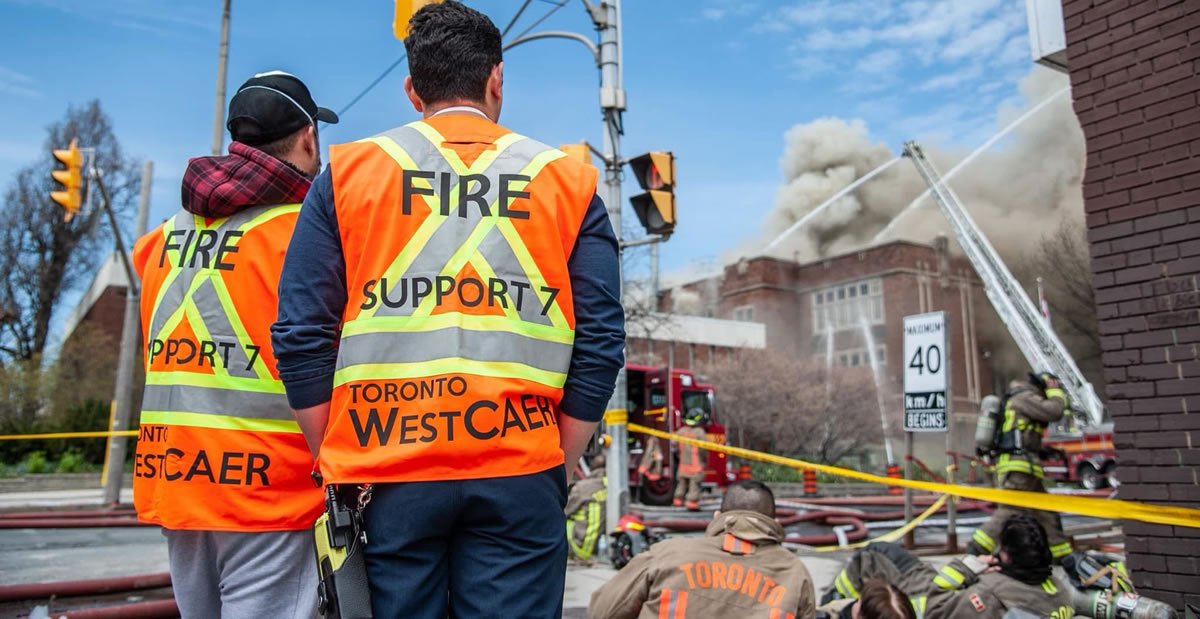
Like the general public, they believe firefighters are heroes (which they are), but they go further, and thanks to their ability to formally organize, communicate with others like them, fit in, and their willingness to assist when called on, we now include them as a special part of the fire service – especially for fire-ground rehabilitation.
They’re called ‘fire buffs’.
According to Walt McCall, a fire buff, author and historian from Windsor, ON, writing on gtmaa.com, to the extent that a ‘buff’ is someone, “with an intense interest or passion in virtually any subject,” the title actually originates in the fire service with fire buffs. Walt writes;
“The very origin of the word “buff”can be traced to the fire service? More than a century ago, as the legend goes; civilian supporters of the New York City Fire Department [FDNY] were frequently seen at extra-alarm blazes, regardless of time or temperature. Standing on the sidewalk, watching their helmeted heroes hard at work, these well-to-do citizens were conspicuous in their (expensive) buffalo-hide robes or coats, hence their nickname “the buffaloes” – inevitably short-formed to “buffs”.
Walt continues, “A fire buff, therefore, is a person with an all-consuming interest in the fire service. Mostly civilians, they are ardent admirers and enthusiastic supporters of all firefighters and the job they do. More than a few firefighters — professional and volunteer – are also avid fire buffs in their off-duty hours.
“Fires to us are not mere spectacles,” Walt quotes Baltimore fire buff Karl Detzer as saying. “They are demonstrations of strategy and tactics, for behind the apparent confusion at any working fire there is generalship,” Detzer continued, “A real buff can tell at a glance just how the battle lines are drawn. The placement of hose lines and ladders, the use of high-pressure turrets and water towers, the location of windows being smashed with axes – all these are clues as to what kind of fire it is, where it is centred and how the job of extinguishing the blaze is progressing.”
Walt believes that fire buffs are comparable in many respects to sports fans, except that, “Fire buffs are basically eager students of the science of firefighting with a parallel interest in a host of other activities, such as compiling fire department histories; photographing apparatus, stations, and fires; building model fire engines; monitoring radio scanners; and collecting/trading patches.
Putting it together, at least in Ontario, probably starts with the formation of the Box 12 Association in 1948 eventually providing canteen services to Toronto firefighters at fire scenes and various events. Box 12 refers to the first alarm box pulled during the Great Fire of Toronto, which started on April 19, 1904 at about 8:04 p.m. in the E&S Currie Limited neckwear company at 58 Wellington Street West. That fire destroyed more than 100 buildings.
I started with the (then) Toronto Fire Department in 1983, and, like many other very thankful firefighters, I was served both hot and cold refreshments, snacks and food by Box 12 during long and multiple alarm fires – well before we formalized the concept and practice of rehabilitation. The Box 12 Canteen truck, during my time, was supplied with food and refreshments by the Toronto Fire Fighters Association, Local 113, International Association of Fire Fighters (IAFF). It was a good and necessary idea, and it wasn’t limited to Toronto. In 1975, a group of fire buffs started the Metro Toronto Multiple Alarm Association (MTMAA), which took over operation of the canteen truck for the Scarborough Fire Department in 1977, and then for the Etobicoke and Mississauga Fire Departments in 1979.
By that time, the United States already had a model for bringing it all together. In 1953, the story goes that a group of fire buffs from the Milwaukee Fire Bell Club gathered at a “famous Milwaukee, Wisconsin restaurant,” and decided to from the International Fire Buffs Associates (IFBA) as a means of bringing together and organizing fire buffs globally. They also decided to hold an annual gathering of fire buffs. In fact, the 72nd IFBA Convention in 2025 will be held in Ottawa-Gatineau, Canada during September 14th through 18th.
A similar story occurred for Canada when a number of our fire buffs coincidentally met at the convention of the Society for the Preservation and Appreciation of Antique Motor Fire Apparatus in America (SPAAMFAA) in Syracuse, NY in 1968. It took a while to materialize, but in 1971 they formed the Ontario Fire Buffs Associates with objectives that included:
- The dissemination and collection of knowledge of the Ontario fire service, past, present and future.
- The encouragement of friendship and interchange of ideas among its members and the promotion and maintenance of high standards of conduct among its members.
- The encouragement of fire departments and / or individuals to retain and restore vintage firefighting apparatus and equipment and to preserve all matter pertaining to the history of the fire service.
- The assistance to fire departments in the fields of fire prevention, fire department displays, photography or any other way requested.
- The publication of a bi-monthly newsletter, to be known as the “Third Alarm”.
- The assistance in the creation and support of a fire service museum.
The 54th Annual OFBA business meeting and 34th OFBA Fire Service Collectibles Show will take place at the Toronto (ON) Fire Academy on November 1, 2025.
Photography and photo tours have been fire buff specialties for many years. If you want to know what trucks were in what firehalls at any particular time, ask a fire buff – they’ll have well-catalogued pictures to prove what they tell you. I didn’t understand the true value of this as a firefighter until I retired and realized I didn’t have any pictures of the many apparatus I was on over 40 years. They would be fun to show kids and grandkids as the new electric fire apparatus are being delivered. My first truck? A 1952 American LaFrance open-cab aerial – with a bell on the front bumper! We need more bells on fire trucks.
They do a lot for firefighting. They know a lot about firefighting. They’re friends, and they’re colleagues…doing what they do only for the love of doing it.
Fire Buffs – I’m glad I was able to write this to celebrate them.
Thanks for looking after me all those years. I will not forget you.
You can visit the Greater Toronto Multiple Alarm Association (GTMAA) at: Greater Toronto Multiple Alarm Association
You can visit the Ontario Fire Buffs Associates (OFBA) at: Ontario Fire Buff Associates | Ontario, Canada
You can visit the International Fire Buffs Associates (IFBA) at: International Fire Buff Associates, Inc. – International Fire Buff Associates, Incorporated.
You can SPAAMFAA at: About – SPAAMFAA – Society for the Preservation & Appreciation of Antique Motor Fire Apparatus in America