Practice For Recruitment Agility Testing
If you want to become a firefighter, you’re going to be doing an agility test, which, frankly could just as easily be called an ‘ability’ test, or a physical ‘aptitude’ test.
You’re going to be required to perform physical manoeuvres, likely within stated time limits, intended, as much as possible, to simulate the most common physical tasks performed by firefighters on the fireground.
If you’re lucky, it will be the Candidate Physical Ability Test (CPAT) jointly developed by the International Association of Fire Chiefs (IAFC) and the International Association of Fire Fighters (IAFF) through the Fire Service Joint Labour Management Wellness-Fitness Initiative in consultation with 10 of North America’s leading fire departments and unions. There are other tests, and you should practice for the test that will be used for your application(s). I like the CPAT because it has an extensive history of challenges and resulting modifications that make it valid (statistically), reliable (statistically), and defensible (legally).
There’s a good chance you’ll be doing the same agility test more than once, and some of them can become quite costly, so it’s a good idea to practice…a lot. Like other agility tests, the CPAT certificate you receive for successful completion has an expiry date. That’s why it’s often the last thing you do before submitting your first (and subsequent, if your certificate has expired) application(s). The test is physically and mentally demanding, thus, if you intend to become a firefighter in a jurisdiction that requires other costly qualifications, e.g., pre-service education such as National Fire Protection Association (NFPA) 1001 Standard levels I and II, it might be a good idea, if it’s affordable, to try the agility test (we’ll assume CPAT) early in your journey.
Yes, you can (and should) practice for the CPAT. In fact, you may, for a fee, be able to practice in an actual CPAT testing facility. Yes, there are hints and ‘tricks’ that can be used. The Internet is full of suggestions, but you absolutely should first check to make sure any manoeuvres you intend to use will not disqualify you. For example (for illustrative purposes only), if you are asked to insert a pike pole into a (likely mock) ceiling and pull it down (something you’ll do a lot in a large urban department), it’s more difficult to do by holding the pike pole and simply pulling with the strength of your arms than by holding the pike pole, pulling with the strength of your arms, and, at the same time, lowering your body toward the ground – giving you the additional downward force. If you are asked to simulate opening a heavy roof hatch with a pike pole, it’s more difficult to clasp the pole with your hands and push upward than it is to bend at the knees, clasp your hands together, place the bottom of the pole in one palm and push upward while, at the same time, standing – thereby combining the strength of your hands, shoulders and legs. You’re going to be a firefighter – it’s important to be strong and smart.
Muscle memory is an important reason you practice. It took my youngest son several years of applying and testing to become an operations firefighter. His brother switched from communications to operations about two years later. We practiced a lot…and we didn’t always pass the test (that’s for a later issue, but you can review my thoughts on recruitment perseverance in our first issue).
I realize not everyone has a sibling to help them practice…but you can perhaps start with someone from your pre-service education class – after all, you’re hoping to be calling them ‘brother’ or ‘sister’ at some point (and yes, we should be considering more neutral terms). Friends, family and neighbours also work.
We live in Ontario, the test most applicable to us was not the CPAT, and it actually required using an axe to cut a hole in a wood simulated roof, so let’s use that as an example. I went out and bought several 2”X4” boards and nailed them together so I could place a sheet of 4’X8’ oriented strand board, or plywood over them on an approximate 40 degree angle. My sons had turnout gear they had purchased as pre-service education students, but it’s also possible that some turnout clothing facilities either rent, or sell retired turnouts. We used a weighted vest to simulate SCBA. I purchased a firefighting axe at Princess Auto. Away we went.
We read the description for the test several times and agreed on the requirements. I set up a small camera (just as easy to use a phone) on a tripod, and when they were ready I started a stopwatch and turned the video camera on. I turned it off at the time limit. We then sat together and watched the video in a form of ‘post-incident analysis’. It wasn’t long before we were able to critique our performance without the camera.
As I recall, the CPAT has a requirement to use a sledge hammer to hit an object on sliders until it moves a certain distance. Buying a sledge hammer was easier than finding a large truck tire to hit, which, by the way, is still in the backyard – in case one of the grandchildren decides they, too, want to be a firefighter, I suppose.
Those who visit my house today sometimes ask why I have a piece of foam pipe insulation on the outer edge of my eaves trough. Well, that was to prevent damage to it from throwing the extension ladder (also in the backyard) up so often over the years – practicing ladder raises, climbing, raising a roof ladder (a step ladder actually), taking a ‘leg lock’, using knots to hoist equipment, and…very rarely, to actually clean the trough (best to ask them before they get tired…or frustrated).
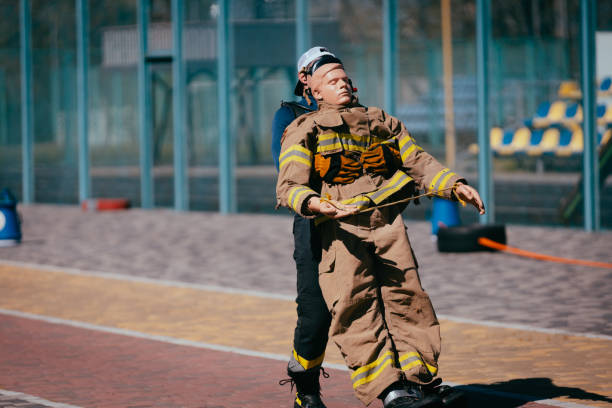
I’ve been ‘dummy’ dragged across the living room carpet, tied to a board, and a lot more, and ‘Mom’ has been the victim in more accident simulations than she cares to remember.
A cute story…during the pandemic the price of plywood for our vent simulations went through the roof (pun intended). We were practicing in the backyard. At the same time, my neighbour was having a new back deck professionally installed. After we axed three holes in a sheet, we removed it, broke it into manageable pieces, tossed it aside, and affixed the next sheet. On the third sheet, we noticed the installers standing on their deck work looking at us over the fence. “Is everything okay?” I asked. “That’s real hard to watch,” we heard back. “Them practicing?” I replied. “No,” came the answer, “Destroying hard-to-get $100 pieces of plywood.” We could only smile.
Don’t forget a gym. Most gyms have equipment that will help you develop the muscles and strength, and possibly even the muscle memory, you will need for agility testing. They certainly have the treadmills you will need to practice for fitness testing, especially VO2 (for another issue).
You do what you have to do. You give it a lot of thought, and research, and you do what you hope will develop your best muscle memory. You do what you can with the resources you can muster, no matter how minute.
If you really want the job, what you don’t do, is quit.
You can learn more about the CPAT at: Candidate Physical Ability Test (CPAT) – IAFF